

Geely Auto has brought Qoder into smart cockpit, intelligent driving, and owner app development, using web previews, unit tests, Repo Wiki, and code analysis to improve collaboration and extend AI-driven efficiency gains from coding to the full automotive software lifecycle.
Back
 Geely Auto has recently brought Qoder into its R&D work across smart cockpit, intelligent driving, owner app, and other development scenarios.
As a major player in the intelligent transformation of China's automotive industry, Geely Auto continues to advance its full-domain AI strategy. In 2025, Geely Auto's total revenue reached RMB 345.2 billion, up 25% year over year, and its cumulative sales reached 3.025 million vehicles, up 39% year over year. As its business scale and the complexity of automotive software continue to grow, R&D efficiency, cross-platform collaboration, and delivery quality have become critical to bringing intelligent features to market.
Earlier this year, Geely launched Full-Domain AI 2.0 and Qianli Haohan G-ASD 4.0, driving intelligent coordination across the cockpit, chassis, assisted driving, and other domains. AI innovation is also reaching deep into Geely's organization. According to Geely's 2025 ESG report, the company has held multiple company-wide training sessions and AI competitions to promote the adoption of AI products in vehicle software development, enterprise efficiency, and service experience. Today, Qoder is becoming part of frontline R&D engineers' daily work and efficiency practices, bringing noticeable changes.
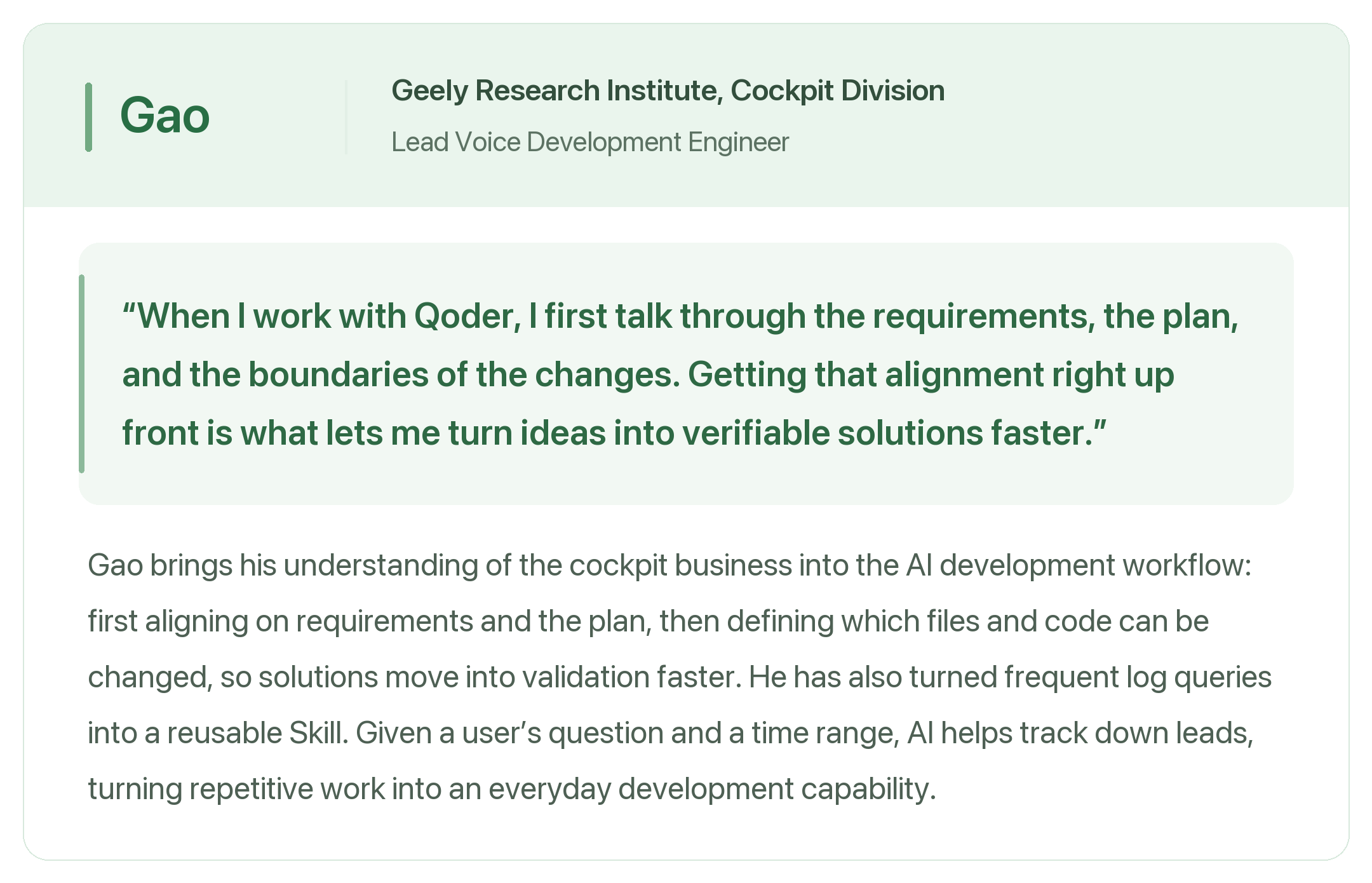
In smart cockpit development, Gao, a lead voice development engineer, wanted the in-vehicle system to show illustrated instructions tailored to the current vehicle model when answering questions such as "How do I use the windshield wipers?" In the past, image sizes and layouts had to be adjusted repeatedly, often requiring three to five rounds of validation on test benches or in actual vehicles. With Qoder, he quickly built a web preview interface and generated five or six design options at once. He could compare them on his computer first and then validate them in the vehicle, significantly shortening the development cycle.
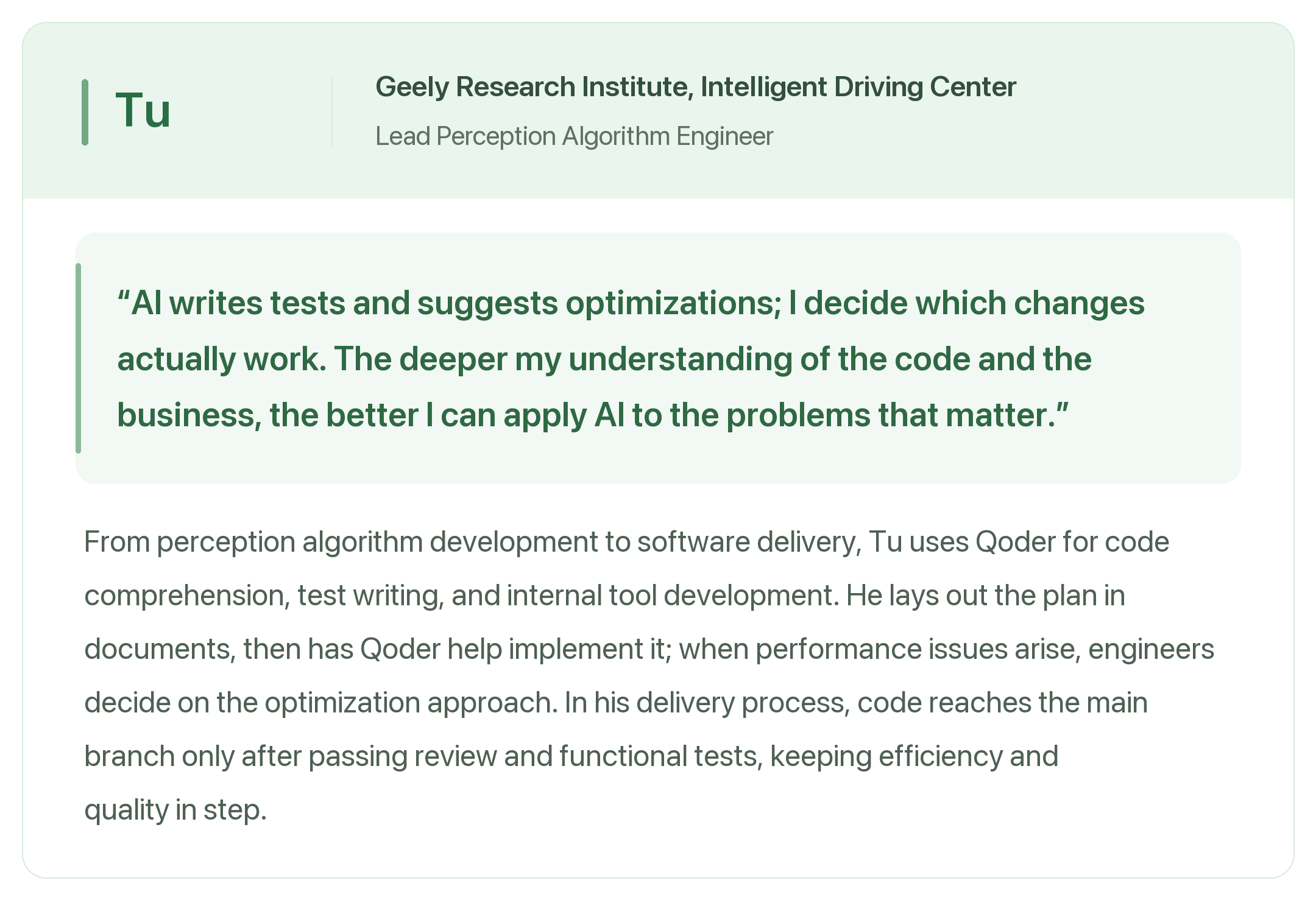
In intelligent driving development, Tu, a lead perception algorithm engineer, needed to integrate upstream models and post-processing code into a deliverable software release. Some exception branches are difficult to trigger through real-world scenarios or data replay, yet each one still has to be verified. He uses AI to help write tedious unit tests, so he can focus more on whether critical cases are covered and whether the results are correct. When working with an unfamiliar project, he first uses Qoder's Repo Wiki to map out the code structure before diving into the hard problems.
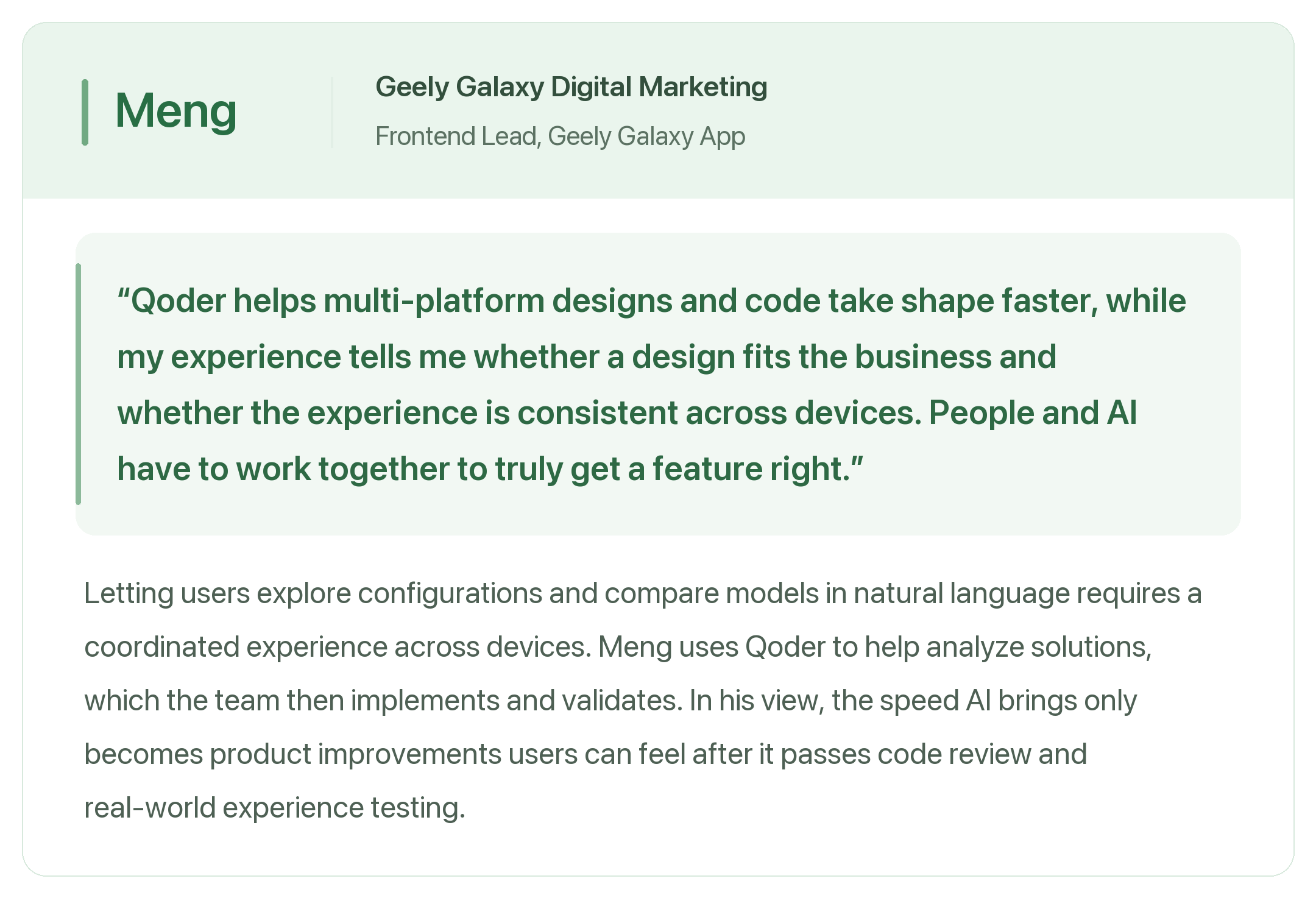
In owner app development, Meng, the frontend lead for the Geely Galaxy app, uses Qoder to optimize the multi-platform experience of its AI shopping assistant. When streamed responses were displayed inconsistently between Android and H5, he handed the existing code to Qoder for analysis to help the team align on an implementation approach. When troubleshooting, he also uses Qoder to analyze large crash dump files. As he recalls, some difficult problems used to take several days just to find a direction; now, troubleshooting leads emerge within tens of minutes, helping the team move more quickly into verification and resolution.
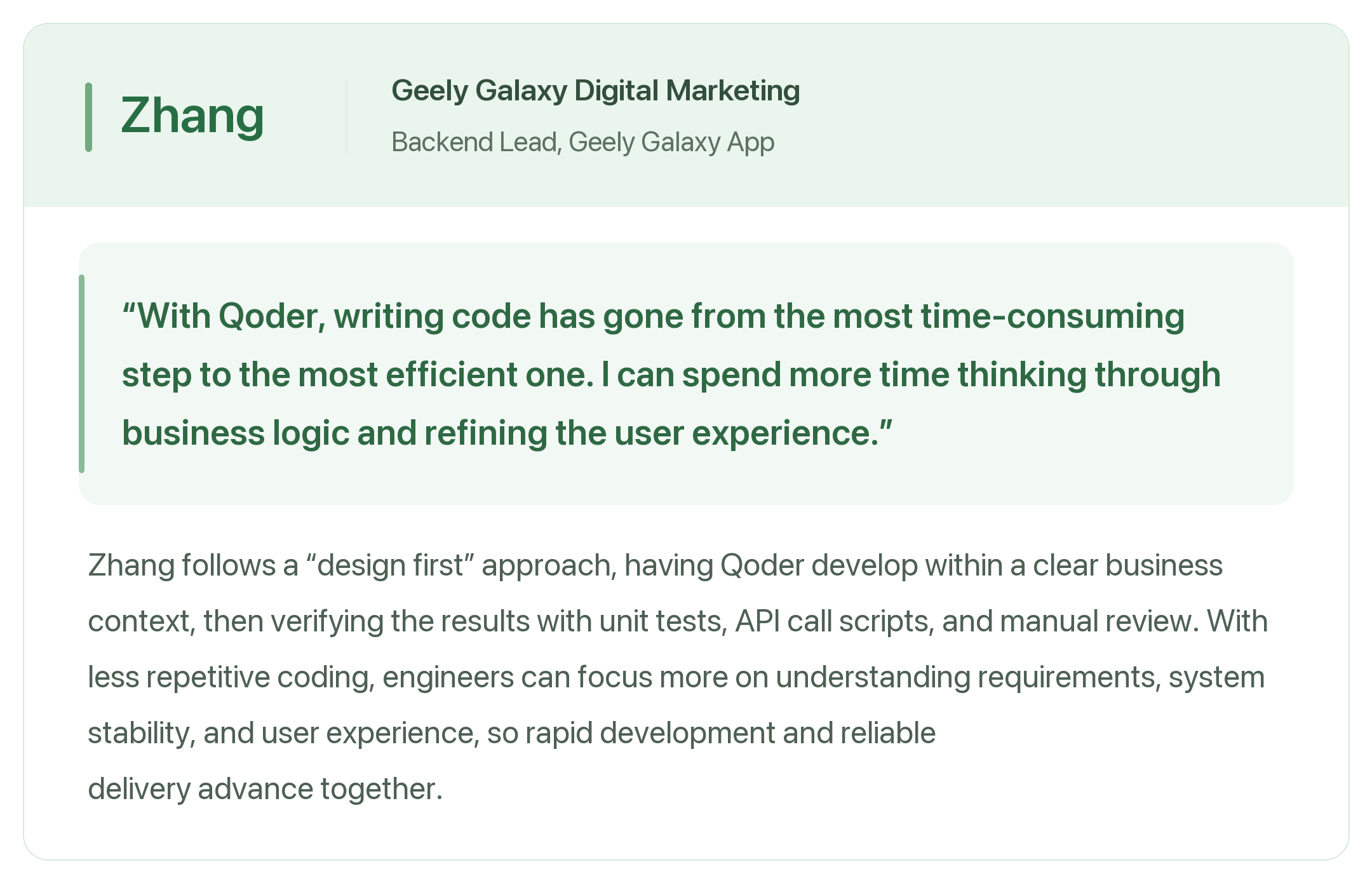
 On the backend, Zhang, the backend lead for the Geely Galaxy app, develops requirements such as the homepage refresh and owner feature pages together with Qoder. He first maps out interactions with external systems and fills in the technical documentation, then generates the design and code, followed by core code review, integration testing, and self-testing. For some smaller requirements, aligning on the design and generating code takes half a day, and fine-tuning takes another half day before the work is ready for delivery. Project conventions and past experience accumulated during development are also being organized into knowledge that AI can understand and reuse.
Geely and Alibaba Cloud have a long history of collaboration. In 2023, Geely Holding Group and Alibaba signed a strategic cooperation agreement. Over the years, Geely and Alibaba Cloud have combined automotive R&D needs with cloud computing, big data, and AI capabilities to jointly build an integrated "cloud, data, and intelligence" computing platform.
These frontline practices are also concrete starting points for the harness engineering co-creation between Geely Auto and Qoder around automotive business: integrating business knowledge, development conventions, tools, and verification workflows into the AI's working environment, so that engineers' expertise and AI capabilities complement each other, and extending efficiency gains from code writing to more stages of software development.
Going forward, Geely Auto and Alibaba Cloud will continue to deepen their AI collaboration, using real automotive business needs to drive co-creation of Qoder's product and engineering practices. Together, they will explore ways to improve efficiency and quality across the full automotive software lifecycle and set a benchmark for intelligence in the automotive industry.
Smart Cockpit Development
In smart cockpit development, Gao, a lead voice development engineer, wanted the in-vehicle system to show illustrated instructions tailored to the current vehicle model when answering questions such as "How do I use the windshield wipers?" In the past, image sizes and layouts had to be adjusted repeatedly, often requiring three to five rounds of validation on test benches or in actual vehicles. With Qoder, he quickly built a web preview interface and generated five or six design options at once. He could compare them on his computer first and then validate them in the vehicle, significantly shortening the development cycle.
Intelligent Driving Development
In intelligent driving development, Tu, a lead perception algorithm engineer, needed to integrate upstream models and post-processing code into a deliverable software release. Some exception branches are difficult to trigger through real-world scenarios or data replay, yet each one still has to be verified. He uses AI to help write tedious unit tests, so he can focus more on whether critical cases are covered and whether the results are correct. When working with an unfamiliar project, he first uses Qoder's Repo Wiki to map out the code structure before diving into the hard problems.
Owner App Development
In owner app development, Meng, the frontend lead for the Geely Galaxy app, uses Qoder to optimize the multi-platform experience of its AI shopping assistant. When streamed responses were displayed inconsistently between Android and H5, he handed the existing code to Qoder for analysis to help the team align on an implementation approach. When troubleshooting, he also uses Qoder to analyze large crash dump files. As he recalls, some difficult problems used to take several days just to find a direction; now, troubleshooting leads emerge within tens of minutes, helping the team move more quickly into verification and resolution.