

Full Truck Alliance uses Qoder Quest Mode to develop a state-machine-based agent framework, combining Repo Wiki, Skills, and MCP to bring AI into its workflows. The team built a framework in about a week, delivered its first agent version within a month, and improved shipping field accuracy by approximately 12 percentage points through prompt optimization.
Back
 On September 22, Li Xuze, Senior Algorithm Expert at Full Truck Alliance, delivered a talk titled "Qoder in Freight: Full Truck Alliance's AI Algorithm Practices" at the Yunqi Conference session "Qoder Powers AI-Native Super Organizations."
Starting with the relationship among freight, trucks, and drivers, Li traced Full Truck Alliance's evolution from an information platform to a transaction platform, and then to an AI platform. Six business agents are already live. Automated prompt optimization improved field accuracy in the shipping scenario by approximately 12 percentage points, while collaboration with Qoder has substantially improved productivity in some development scenarios. The team produced an agent framework in about a week and delivered the first agent version within a month. Li concluded with a formula for output in the AI era—"judgment × Qoder's AI execution capability"—and returned to the company's most fundamental goal: enabling drivers' wives to return home so children living apart from their parents can have their mothers by their side.
The following is the full talk in translation.
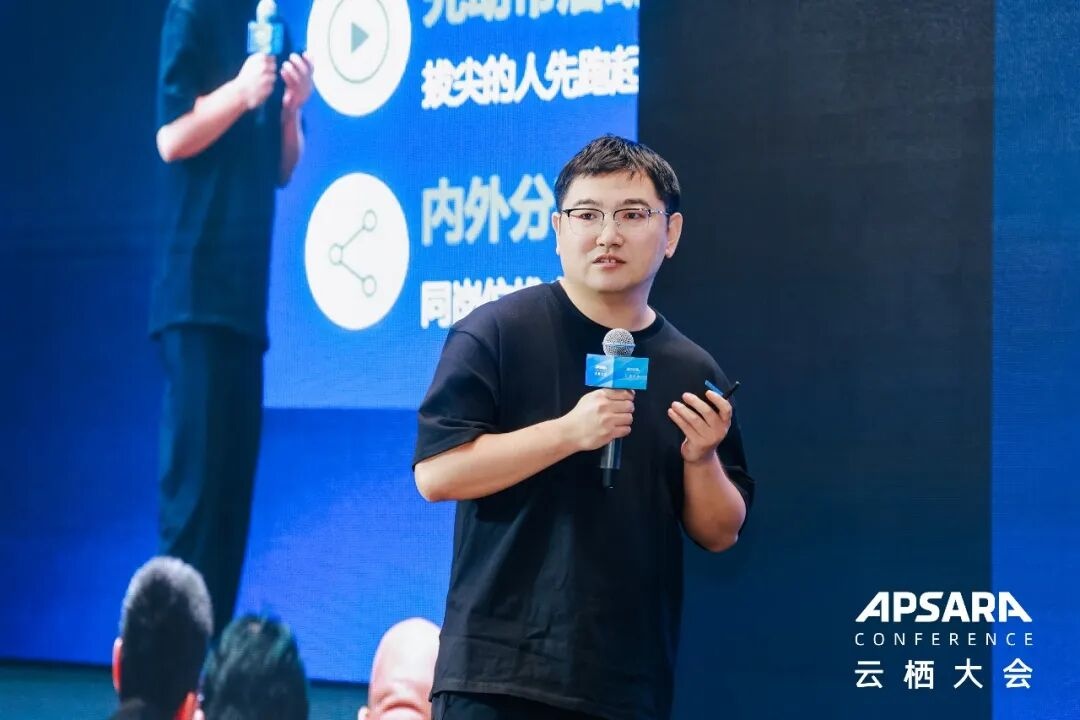 Hello, everyone. I'm Li Xuze from Full Truck Alliance. Thank you to Qoder for the opportunity to share our experience. My talk is titled "Qoder in Freight."
I'll cover four areas: who Full Truck Alliance is, the challenges we encountered during our transformation and our overall AI landscape, our practices with Qoder, and finally, some personal reflections on AI.
Yunmanman was founded in 2013. In 2017, it merged with Huochebang to form Full Truck Alliance Co. Ltd. (FTA), which has become a leading company in China's digital line-haul logistics sector.
Full Truck Alliance is a platform built around freight, trucks, and drivers, connecting the platform, shippers, and drivers. Each side has its own business needs. Four characteristics define our business: deep domain expertise, significant mismatches in time and location, highly uneven transport capacity, and a large population of independent drivers.
Independent drivers often have a "co-driver" in line-haul freight operations, and that role is frequently played by their wives. The husband drives, while the wife helps find freight and communicate with shippers. Their children may stay at home with their grandparents. In the agent era, there may be a new solution. I'll leave that thought here and return to it at the end.
Our AI transformation presented four major challenges. We framed them as four questions: What should we do? Can we do it? Who will do it? And what value will it create?
First, what should we do? To use an analogy, AI in a business-facing setting is like a high school student, while AI in a consumer-facing setting is like a PhD student. Enterprise use requires a great deal of additional information. We also need to identify which business scenarios are suitable for AI. After exploring different scenarios, we found that standardized products are not always easy to combine with AI: introducing it can disrupt an existing process. For high-stakes decisions, such as buying a home, people are unlikely to let AI decide for them. A better fit is a scenario with a moderate decision burden: a decision is necessary, transaction values may range from hundreds to thousands, and substantial interaction is required. Full Truck Alliance fits this description well. We are a matching platform, with extensive interaction and many business decisions made by people.
Second, can we do it? We found that our enterprise technology stack was relatively old and not well suited to agent frameworks. We needed to develop our own framework.
Third, who will do it? We have a development team of nearly a thousand people, but in 2025, our experience with AI agents was almost zero. We therefore pursued two paths: developing talent internally and recruiting externally.
Fourth, what value will it create? Internally, improving the productivity of our nearly thousand-person development team, along with operations and testing roles, can produce clear benefits. The next step is to bring AI into the business itself so it serves our customers.
Think of our overall workflow as a pipeline. Every part of that pipeline needs to incorporate AI.
On the business side, we already have six agents live. Business teams use Qoder to write market requirements documents (MRDs), analyze data, and build data feedback loops. Developers use Qoder together with Full Truck Alliance's development standards to generate code. Testing teams combine Qoder with Skills for automated testing.
The relationships among the platform, shippers, and drivers also lead to dedicated agents. Shippers have agents for posting shipments and following up on orders, while drivers have an agent for finding freight. Our goal is to let agents take over tasks that shippers and drivers previously handled themselves, allowing users to focus on their own priorities while agents manage the rest.
At present, agents have been rolled out across our fulfillment and liability determination operations, and an agent has taken over the handling of key customer complaints.
Why did we choose Qoder? There were several reasons.
First, Alibaba's backing. Second, security and trustworthiness: data security is the top priority in the AI era. Third, enterprise knowledge capabilities. Fourth, the ecosystem: Qoder is not a standalone tool. The Qoder family supports different stages of productive work and provides a broad set of capabilities.
An AI-native organization needs to develop not only its technology, but also its culture. We are also cultivating highly capable individuals internally, who can help spread an AI culture throughout the group.
To grow in the agent era, a company needs a self-reinforcing system. Cases, user memories, and knowledge should continuously feed back into the process, helping its agents improve.
This raises the question of prompt optimization. Many business prompts exceed ten thousand tokens and are difficult for people to maintain. Beyond a certain point, adding another rule no longer improves accuracy—it reduces it. How can we automate this work?
We use a reinforcement-learning-based loop, broken down into an optimizer, a candidate pool, and LLM inference. We built an evaluator using a real gold-standard dataset and iteratively refine the candidate pool. An accuracy delta determines when the target has been met and iteration can stop, producing the best prompt. In the shipping scenario, field accuracy improved by approximately 12 percentage points.
This is one of the development needs we have addressed through close collaboration with Qoder. Our specialty is algorithms, not software development, so development can be difficult for our algorithm engineers. By working with Qoder from architecture and requirements analysis through implementation, work that previously required around 50 person-days may now take around 10 person-days. The improvement is substantial.
Let me describe three areas of collaboration. As I mentioned, we had no agent implementation experience in 2025, and our older technology stack added another challenge. How could we develop the necessary capabilities in-house?
First, developing our own agent framework. Although we had no prior experience, we worked with Qoder's Quest Mode and produced our agent framework in about a week. People often think posting a shipment is simply filling out a form, but it is actually an order process. It requires field accuracy and dependencies among fields, making it strongly state-machine-oriented. With Quest Mode, we implemented a state-machine-based agent development framework in roughly a week and delivered the first agent version within a month.
Second, the knowledge base. Previously, each team member had to maintain their own wiki and document their code in it. Now, Qoder generates Repo Wiki documentation as code is committed. Everyone can consult that wiki without needing to coordinate individually with colleagues; they only need to commit their code.
Third, troubleshooting. The old process involved people identifying where something had gone wrong and then searching through a large amount of code. It might take a day or two to resolve a problem. Now, Qoder provides a web-based agent. We give it the link and work through the issue in conversation, examining code while troubleshooting.
Looking back, we have an older technology stack and many systems. Our existing systems use RPC frameworks. How can those interfaces support an AI-native organization? They need to be adapted for MCP. Our colleagues can collaborate with Qoder to automate the conversion of RPC interfaces into MCP-compatible tooling.
For us, Qoder's most important strengths are efficient development; a growing understanding of the user as it is used, supported by accumulating Memory; powerful agents that can continue to improve; access to new models as they become available; and an enterprise knowledge base that grows with the team.
When a company wants to become an AI organization, it might assume that getting from zero to one is enough. But helping frontline employees make that transition is not necessarily easy.
You have to show them how AI can improve their work. Our approach is to establish role models.
There are broadly three groups when building an agent culture: early adopters, those who wait and observe, and those who remain disengaged. By developing agents and highly capable individuals, we can show the others what AI-driven productivity looks like and encourage them to participate.
But a highly productive individual does not automatically make the whole organization more productive. Vibe Coding may improve a developer's efficiency, but does that necessarily improve organizational efficiency? No. A barrel's capacity is determined by its shortest stave, not its longest. That is why every role along the entire workflow needs to incorporate AI. We must look at the whole system rather than isolated improvements and examine each stage in turn.
Ultimately, this has to reach the business. Individual productivity gains from Vibe Coding and other AI tools are not the same as organizational gains. Organizations need to examine every role from beginning to end. They also have many existing systems on the business and product sides that need to be connected and made AI-enabled. This can reduce communication overhead and help people take on work immediately upstream or downstream from their own roles. Organizations can become flatter in the AI era. Traditional reporting structures require people to repeatedly summarize information. With automated summaries, a manager's span of responsibility can expand.
Finally, some thoughts on the future of AI.
In the traditional era, output was a function of labor multiplied by working hours. That described our capabilities before AI. In the AI era, judgment and Qoder's AI execution capability are what define output.
Experience becomes more important, not less. People who know the problems in their business and understand which problems different users need solved bring increasingly valuable judgment. So the new formula is:
Judgment × Qoder's execution capability = output in the AI era.
Let me return to Full Truck Alliance's underlying purpose. Why are we doing this? Consider the husband-and-wife team I described earlier: the husband drives, and the wife finds freight.
We hope agents can take over the "co-driver" role, allowing wives to return home so children living apart from their parents can have their mothers by their side. That is one of the goals of Full Truck Alliance's AI transformation.
Thank you.