
Zhaopin leverages Qoder to build an AI-native development workflow, extending single-project productivity gains to cross-project requirement decomposition, integration testing, and release preparation.
Back
Founded in 1994, Zhaopin is a leading human capital ecosystem platform in China. Its offerings span online recruitment, campus recruitment, overseas recruitment, executive search, assessment and training, and business process outsourcing (BPO).
Business requirements for its main platform often involve multiple software projects. This case examines how the development team leverages Qoder, alongside its in-house engineering systems, to extend single-project practices to complex requirement decomposition, implementation, developer-led integration testing, and release preparation.
Average daily consumption: more than 100,000 Credits.
The difficulty of cross-project requirements goes beyond writing code. Teams first need to identify the relevant projects, connect interfaces and call chains, and validate the changes in a running environment. Productivity gains for an individual developer do not automatically translate into cross-project delivery capability.
Zhaopin expanded its approach step by step: first establishing a repeatable single-project workflow, then connecting multi-project decomposition, developer-led integration testing, and release preparation. Qoder supports day-to-day development and provides the task entry point. Zhaopin builds and maintains the knowledge base, tool connections, and orchestration. Background executors are referred to collectively as general-purpose Agents / CLIs.
The first is the collaboration burden outside coding. Zhaopin's early internal analysis found that coding accounted for approximately 30%–40% of working time, while communication accounted for roughly 50%. Accelerating code generation alone cannot eliminate the waiting and handoffs involved in reviews, design discussions, and integration testing.
The second is cross-project dependency management. Product managers describe business capabilities, not service boundaries. A single requirement often spans several projects, so AI must first determine which projects are relevant, what each is responsible for, and whether their changes will work together.
The third is maintaining knowledge and architectural constraints through repeated iterations. Even a single-project workflow can suffer architectural drift after multiple rounds of changes. The team therefore introduced domain language, high-level architecture, and coding standards into the process to guide AI's ongoing modifications.
The goal is to make clearly scoped tasks reliable first, then connect cross-project decomposition with developer-led validation. Knowledge, collaboration, and feedback determine whether the process can keep running effectively.
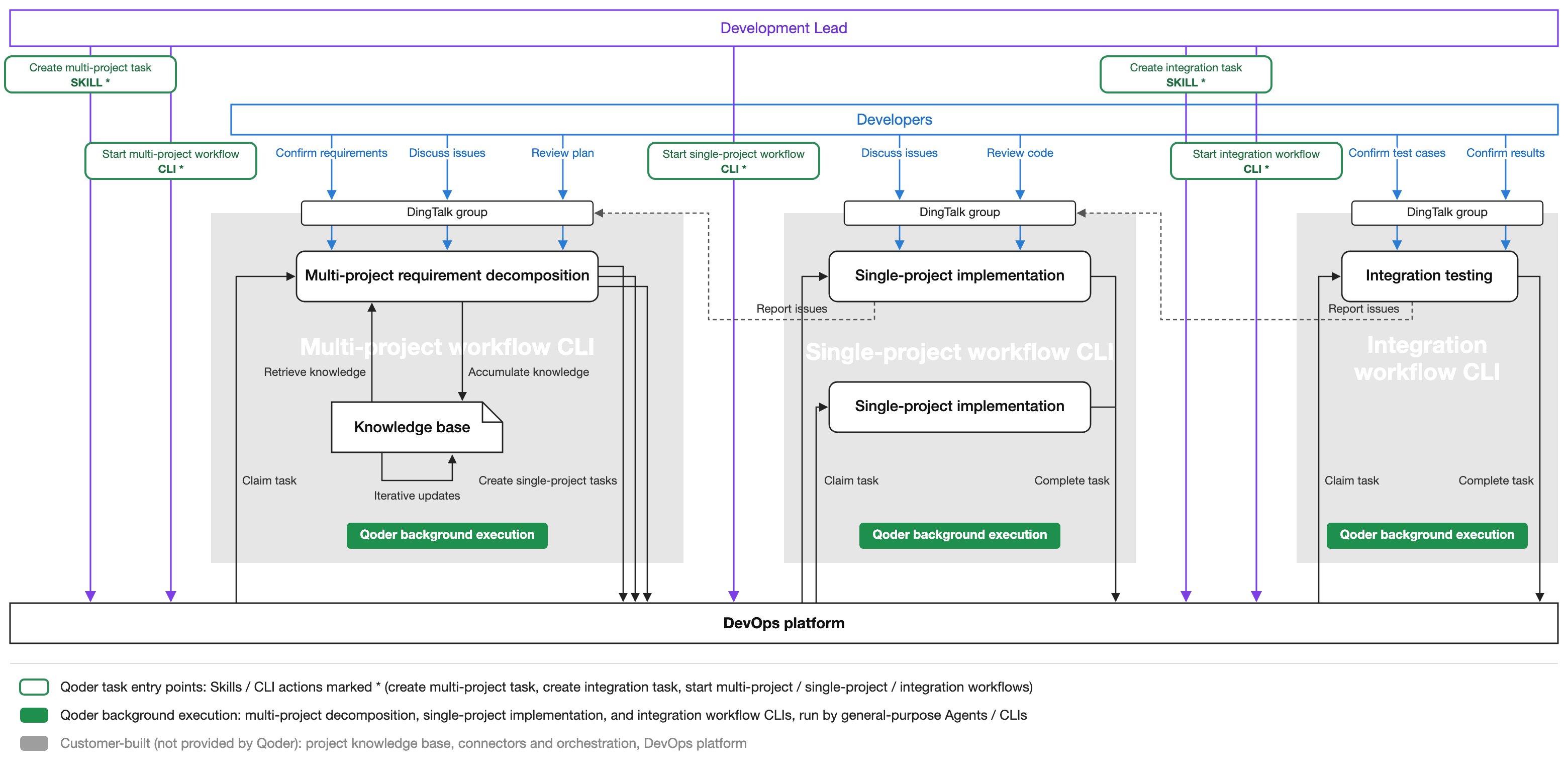 Zhaopin uses general-purpose Agents to execute tasks, while focusing its own engineering investment on DevOps, project knowledge, and tool connections. Task groups provide a space for people and Agents to discuss requirements, review plans, and examine results. The in-house infrastructure connects these discussions to task execution and engineering records.
Zhaopin analyzed more than a thousand projects individually, creating documents that describe each project's responsibilities, interfaces, and related projects. When a requirement arrives, an Agent retrieves candidate projects and then reads the code to verify their relationships. The initial analysis was performed by an in-house specialized Agent connected to a Qwen model.
Discussions are also a source of knowledge. When people propose reusable rules, Skills extract them and add them to the knowledge base, allowing a correction made for one requirement to benefit later work.
Once a task starts, plans and results are discussed in a DingTalk task group. Connectors forward messages to the corresponding Agent and return its results to the group. DevOps links requirements, subtasks, projects, branches, and artifacts, making their status queryable.
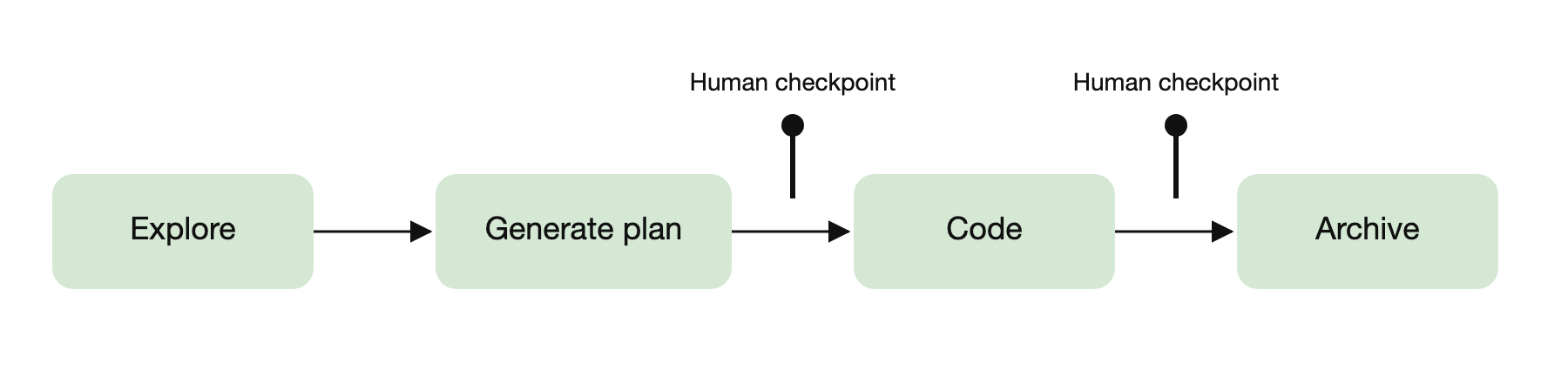
The single-project workflow handles requirements limited to one project or module, as well as single-project tasks produced by decomposition. Its stages are exploration, planning, coding, and archiving, with human intervention after the plan and code are produced.
 A single-project task enters exploration with
To address architectural problems caused by repeated changes, the team explored an evolving workflow: the exploration stage incorporates domain language and high-level architecture, while the coding stage incorporates coding standards.
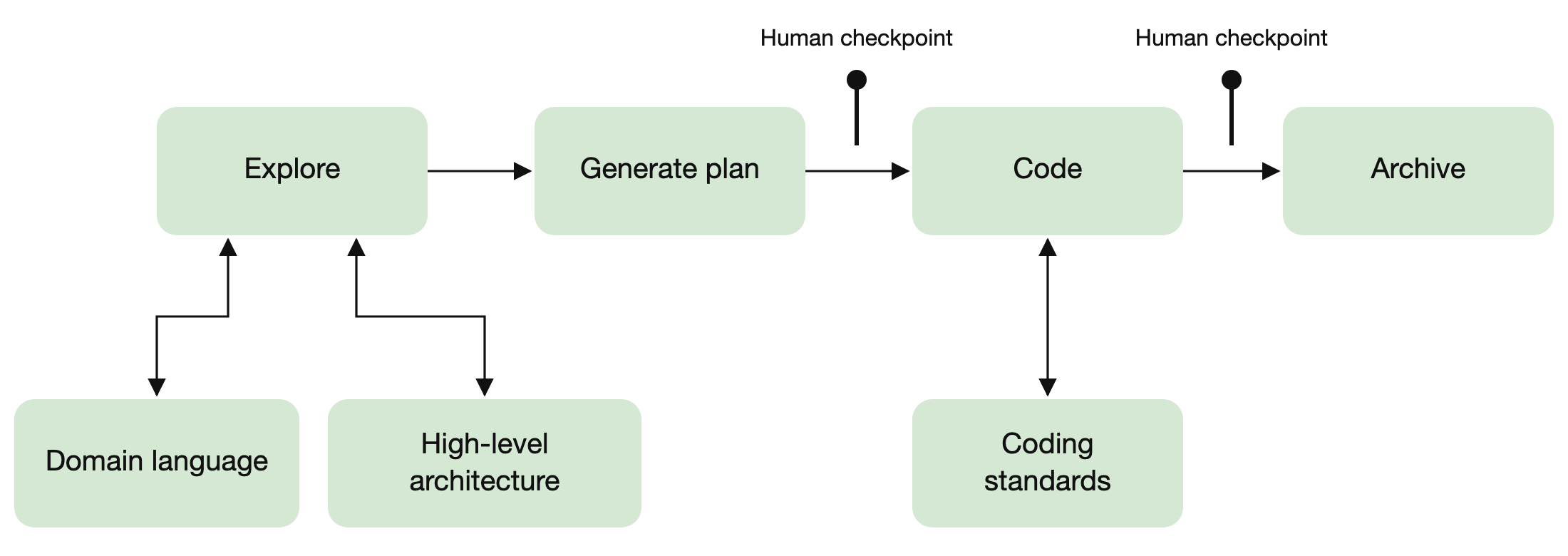
Product managers provide a product requirements document (PRD), design mockups, and related materials. People use Skills or the platform to create and start a DevOps requirement task. Clarification takes place during the organization and discussion stages after initiation.
Requirement clarification → project discovery → per-project analysis → call-chain and documentation consistency checks → group discussion of the solution → finalized plan → decomposition into single-project tasks.
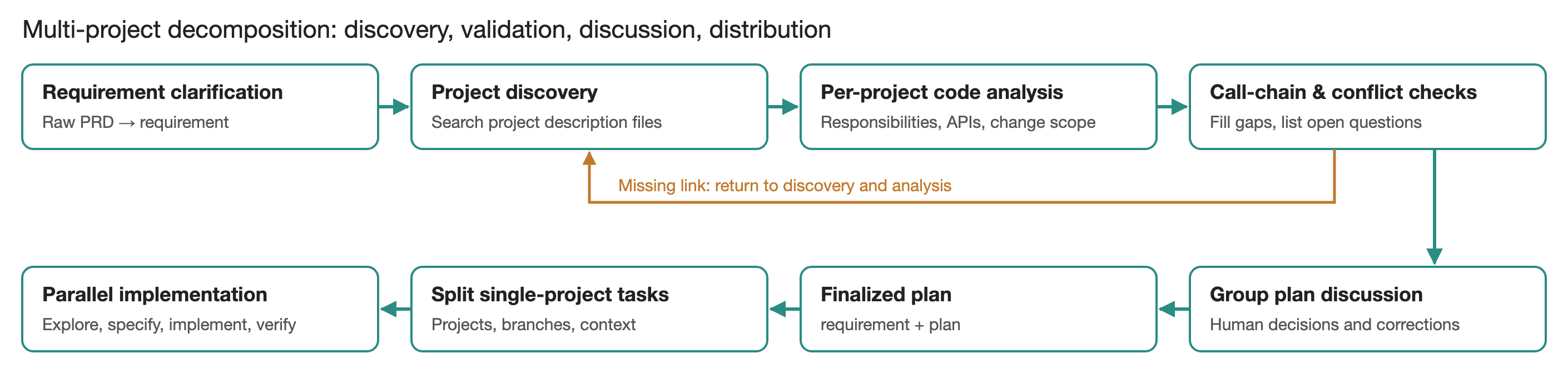 If call-chain validation finds a missing link, the workflow returns to discovery and analysis to fill it in. Ambiguous business meanings become open questions for people to resolve.
The team aligns contracts before distributing the work. Agents consolidate the project analyses, validate call relationships and documentation consistency, and produce a draft with open questions. After developers discuss these in the DingTalk group, the decisions are written back to
When the projects are ready for submission or merging, a person initiates integration testing. The Agent retrieves the requirement, projects, and branches from DevOps, deploys the corresponding versions, and generates and executes integration test cases.
When a test fails, the integration-testing Agent produces a diagnosis and sends the issue back to the relevant implementation group. Once the implementation side reports a fix, the integration-testing side redeploys and retests. Errors can therefore be located, routed back, and handled through a continuing workflow.
This was a complex requirement that collected and processed data from the candidate-facing side of the platform and displayed it on employer-facing pages. It required changes across the frontend, gateway, and backend. Before adopting the AI-native development workflow, this work required at least four developers across the different layers and approximately 25 person-days. With the workflow, one developer completed the work with approximately seven person-days of actual effort.
The employer-facing, cross-project requirement introduced a candidate list with multidimensional filters, a statistics dashboard, and unread indicators. Its data came from candidate-side user behavior. After product requirements and designs were supplied, a person created and started the task, and AI organized
The development platform retained a queryable snapshot of the nine tasks for requirement 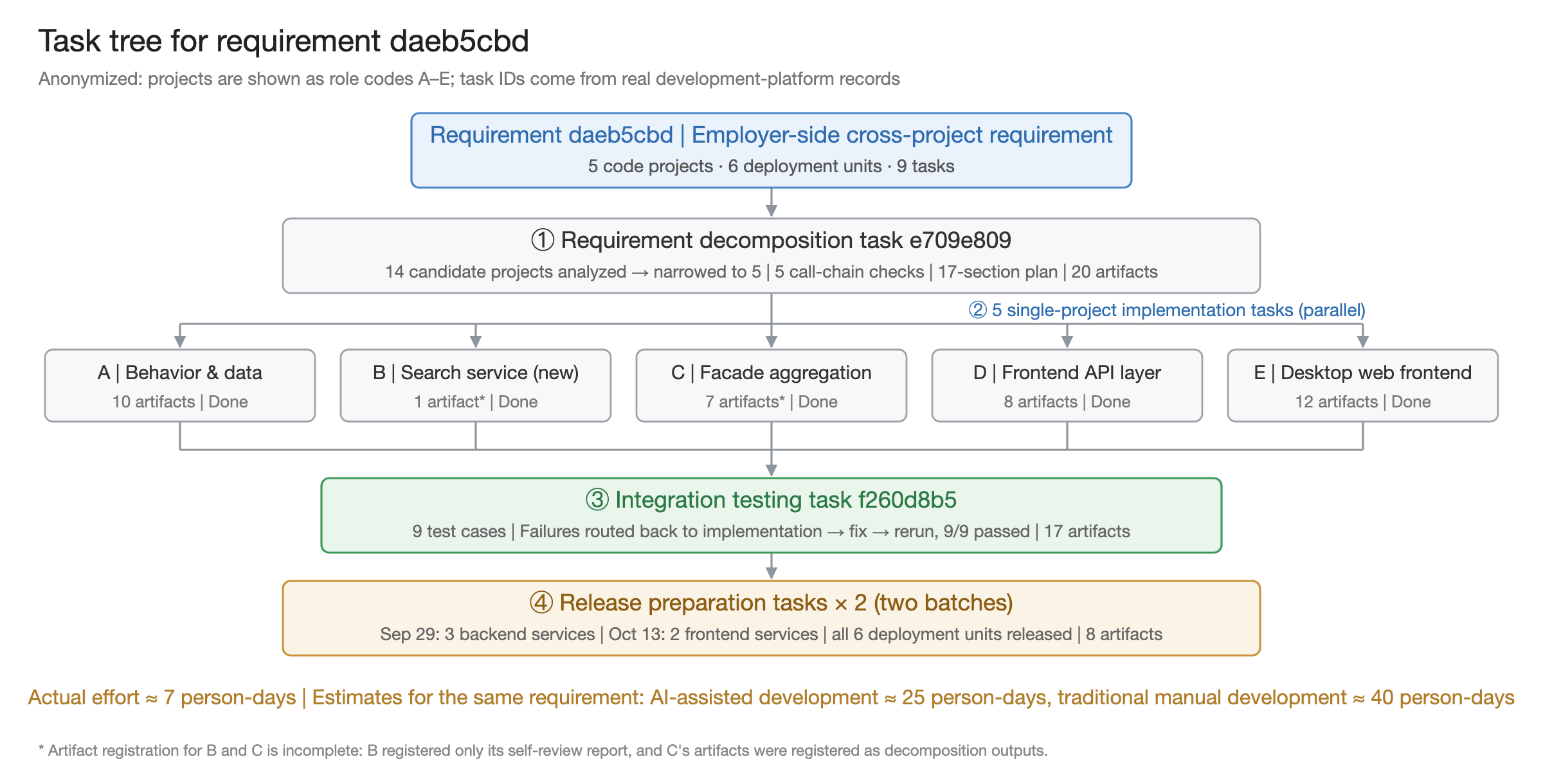 Actual developer effort with the AI-native workflow was approximately seven person-days. The estimate for the same requirement using developer-led work with AI assistance was 25 person-days, compared with 40 person-days for traditional manual development.
The 83 registered artifacts were distributed across the workflow stages as follows:
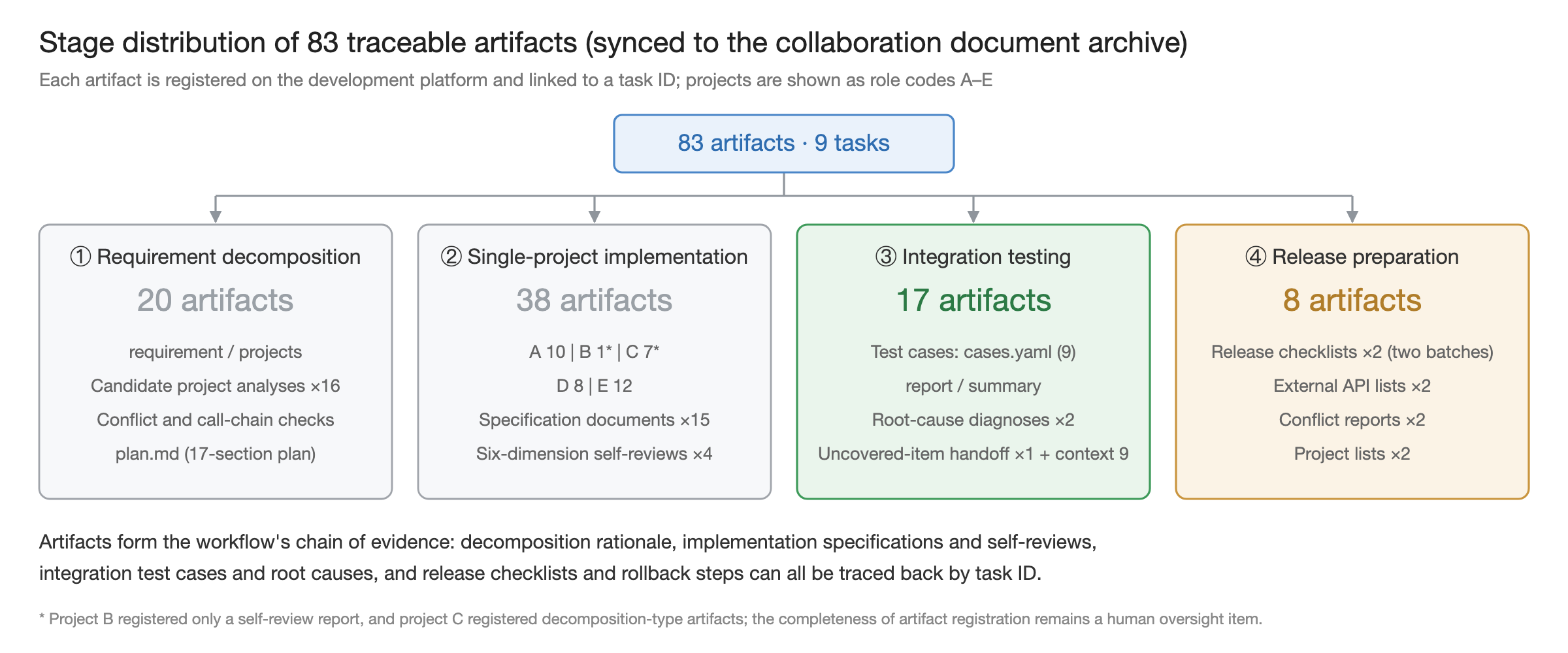 Artifacts were registered on the development platform and linked to task IDs. The integration-testing archive retained test cases, execution reports, diagnoses, and handoff checklists, preserving the reasoning and evidence needed to trace decisions and results.
The feedback log recorded three issue entries, all resolved. They included code defects, an environment problem, and findings from manual validation.
After the implementation side reports its fix commits, the integration-testing side redeploys and validates again. People can also request additional test data or new test cases.
The nine task groups contained 616 messages: 505 from AI and 111 from people, a ratio of approximately 4.5:1. Among the human messages, 96 contained substantive input and 11 were confirmation-only.
The requirement generated nine task groups in which AI and people discussed the work together. Decomposition, implementation, integration testing, and release preparation each had a defined scope of responsibility. The same digital employee account could present the results of different task execution sessions in different groups.
The final integration summary recorded two all-pass rounds, each with a 100% test pass rate. This describes the executed test cases, not full coverage of all business acceptance criteria.
The Agent-generated code rate covers the main projects of Zhaopin's primary platform, approximately 400+ projects.
Requirement throughput means the number of requirements completed per person per month, comparing Q3 2025 with Q3 2026.
The complex-requirement count is the total delivered in Q3 2026.
Individual practices become team workflows. Customer-configured Skills, specialized Agents, and tool connections organize requirement preparation, design discussions, implementation, and validation into repeatable steps. Cross-project collaboration becomes a task flow that carries its context with it.
Make one project reliable first. Start with clearly scoped tasks whose results can be verified, and establish exploration, specification, implementation, validation, archiving, and code review.
Distinguish knowledge types before choosing retrieval methods. A project index answers where to make changes; code analysis answers how the pieces connect; business knowledge explains what customers see and why the rules work as they do.
Connect AI to existing systems. Use documented APIs and Skills to access requirements, projects, code, and operations capabilities. Make clear which states can be queried and which steps must be initiated by people.
Measure successful delivery. Beyond the code-generation rate, track requirement throughput, delivery cycle time, rework rate, integration test pass rate, and the time spent on human intervention.
Zhaopin's practice shows that AI-native development needs to connect requirements, knowledge, tasks, code, and validation results. Zhaopin leverages Qoder to build this workflow together with its in-house engineering systems. Continued gains in delivery capability also depend on the quality of business knowledge and human judgment at key checkpoints.
1. Customer Background: Development Requires Cross-Project Collaboration
Founded in 1994, Zhaopin is a leading human capital ecosystem platform in China. Its offerings span online recruitment, campus recruitment, overseas recruitment, executive search, assessment and training, and business process outsourcing (BPO).
Business requirements for its main platform often involve multiple software projects. This case examines how the development team leverages Qoder, alongside its in-house engineering systems, to extend single-project practices to complex requirement decomposition, implementation, developer-led integration testing, and release preparation.
Case at a Glance
| Customer and scenario | Scope of practice | Key components |
|---|---|---|
| Zhaopin; development for its online recruitment business | Development teams working on the main platform; from requirement decomposition through developer-led integration testing and release preparation, with human review and release decisions retained | Qoder, general-purpose Agents / CLIs, Skills, an in-house knowledge base and DevOps platform, and DingTalk collaboration |
From Faster Code Generation to a Working Development Process
The difficulty of cross-project requirements goes beyond writing code. Teams first need to identify the relevant projects, connect interfaces and call chains, and validate the changes in a running environment. Productivity gains for an individual developer do not automatically translate into cross-project delivery capability.
Zhaopin expanded its approach step by step: first establishing a repeatable single-project workflow, then connecting multi-project decomposition, developer-led integration testing, and release preparation. Qoder supports day-to-day development and provides the task entry point. Zhaopin builds and maintains the knowledge base, tool connections, and orchestration. Background executors are referred to collectively as general-purpose Agents / CLIs.
2. Development Challenges: Faster Coding Is Not Enough
Three Bottlenecks Beyond Code Generation
The first is the collaboration burden outside coding. Zhaopin's early internal analysis found that coding accounted for approximately 30%–40% of working time, while communication accounted for roughly 50%. Accelerating code generation alone cannot eliminate the waiting and handoffs involved in reviews, design discussions, and integration testing.
The second is cross-project dependency management. Product managers describe business capabilities, not service boundaries. A single requirement often spans several projects, so AI must first determine which projects are relevant, what each is responsible for, and whether their changes will work together.
The third is maintaining knowledge and architectural constraints through repeated iterations. Even a single-project workflow can suffer architectural drift after multiple rounds of changes. The team therefore introduced domain language, high-level architecture, and coding standards into the process to guide AI's ongoing modifications.
Turning Business Requirements into Verifiable Engineering Deliverables
The goal is to make clearly scoped tasks reliable first, then connect cross-project decomposition with developer-led validation. Knowledge, collaboration, and feedback determine whether the process can keep running effectively.
3. Overall Approach: General-Purpose Agents and Enterprise Engineering Systems
How Collaboration, Execution, and Engineering Infrastructure Fit Together
Responsibilities: Qoder and Zhaopin's In-House Infrastructure
| Layer | Responsibilities |
|---|---|
| Qoder and general-purpose Agents / CLIs | Qoder supports day-to-day development and task initiation; general-purpose Agents / CLIs execute background tasks. |
| Skills and specialized Agents | Organize workflow steps and specialized tasks. DevOps integration uses API documentation together with Skills, without rewriting the APIs as a dedicated CLI. |
| In-house connectors and orchestration | Pass messages, results, and stage-specific context among task groups, DevOps, and Agents. |
| In-house knowledge base and DevOps | Project knowledge helps identify projects and understand interfaces; development standards constrain implementation; DevOps links requirements, tasks, projects, branches, and artifacts. |
Project Knowledge: Find the Projects, Then Verify Dependencies in Code
Zhaopin analyzed more than a thousand projects individually, creating documents that describe each project's responsibilities, interfaces, and related projects. When a requirement arrives, an Agent retrieves candidate projects and then reads the code to verify their relationships. The initial analysis was performed by an in-house specialized Agent connected to a Qwen model.
Discussions are also a source of knowledge. When people propose reusable rules, Skills extract them and add them to the knowledge base, allowing a correction made for one requirement to benefit later work.
Three Connection Layers: Development Tools, Enterprise Infrastructure, and Collaboration
Once a task starts, plans and results are discussed in a DingTalk task group. Connectors forward messages to the corresponding Agent and return its results to the group. DevOps links requirements, subtasks, projects, branches, and artifacts, making their status queryable.
4. Implementation Path: From Single-Project Tasks to Complex Requirements
Stabilize the Single-Project Workflow with Human Checkpoints
The single-project workflow handles requirements limited to one project or module, as well as single-project tasks produced by decomposition. Its stages are exploration, planning, coding, and archiving, with human intervention after the plan and code are produced.
requirement.md and the multi-project plan.md. AI first lists specific questions about the project, and developers answer them individually. Once the questions are resolved, it produces proposal, design, tasks, and specs in an OpenSpec-style structure before implementation. AI commits the code and provides a merge request (MR) link; developers review it and decide whether to merge.
From One-Off Execution to Sustainable Maintenance
To address architectural problems caused by repeated changes, the team explored an evolving workflow: the exploration stage incorporates domain language and high-level architecture, while the coding stage incorporates coding standards.
From One PRD to a Set of Executable Project Tasks
Product managers provide a product requirements document (PRD), design mockups, and related materials. People use Skills or the platform to create and start a DevOps requirement task. Clarification takes place during the organization and discussion stages after initiation.
Requirement clarification → project discovery → per-project analysis → call-chain and documentation consistency checks → group discussion of the solution → finalized plan → decomposition into single-project tasks.
requirement.md and the finalized plan.md. Once confirmed, linked single-project tasks are created and started in parallel.
Developer-Led Integration Testing: Verify That Projects Work Together
When the projects are ready for submission or merging, a person initiates integration testing. The Agent retrieves the requirement, projects, and branches from DevOps, deploys the corresponding versions, and generates and executes integration test cases.
Send Failures Back to the Original Task to Close the Repair Loop
When a test fails, the integration-testing Agent produces a diagnosis and sends the issue back to the relevant implementation group. Once the implementation side reports a fix, the integration-testing side redeploys and retests. Errors can therefore be located, routed back, and handled through a continuing workflow.
5. A Real Requirement: Delivering a Candidate List Capability
This was a complex requirement that collected and processed data from the candidate-facing side of the platform and displayed it on employer-facing pages. It required changes across the frontend, gateway, and backend. Before adopting the AI-native development workflow, this work required at least four developers across the different layers and approximately 25 person-days. With the workflow, one developer completed the work with approximately seven person-days of actual effort.
Requirement Scope and Project Responsibilities
The employer-facing, cross-project requirement introduced a candidate list with multidimensional filters, a statistics dashboard, and unread indicators. Its data came from candidate-side user behavior. After product requirements and designs were supplied, a person created and started the task, and AI organized requirement.md and clarified questions in the group.
The requirement involved nine tasks: one decomposition task, five implementation tasks, one integration-testing task, and two release-preparation tasks. It registered 83 artifacts across five code projects and six deployment units. One project was newly created, and the same developer handled all five projects.
| Project (anonymized role) | Changes in this release | Key dependencies and handoffs |
|---|---|---|
| A — Candidate-side behavior and data service | Add fields to business tables, produce behavior events, provide dashboard data APIs, and backfill and synchronize existing data. | Supply events and data sources to B; apply schema changes before release. |
| B — Employer-side search service (new) | Set up separate indexing and search deployment units, consume events to build documents, and support filtering, lists, and counts. | Consume events from A and provide query APIs to C. |
| C — Employer-side facade and aggregation layer | Assemble list cards, map filter enumerations, and aggregate dashboard data. | Call B and A, and expose a stable contract to D. |
| D — Frontend API layer | Add frontend-facing endpoints, handle authentication and authorization, validate parameters, and adapt protocols. | Call C and agree on fields and error codes with E. |
| E — Employer-side desktop web frontend | Add the list page and filters, dashboard views, unread indicators, empty states, and analytics events. | Call D; the server determines state. |
Task Records and Effort Comparison
The development platform retained a queryable snapshot of the nine tasks for requirement daeb5cbd, linking decomposition, parallel implementation, integration testing, and release preparation.
Outputs and Human Review at Each Stage
| Stage | AI outputs | Human oversight |
|---|---|---|
| Requirement decomposition | 14 project analyses, five call-chain checks, a conflict-resolution report, and a 17-section implementation plan. | 16 substantive group messages deciding ownership, correcting call chains, adding a missing project, and synchronizing changes. |
| Single-project implementation | 15 specification documents and four self-review reports covering six dimensions, with six blocking issues and 20 recommendations; up to eight review rounds. | The responsible developer reviews code and MRs and confirms solution options individually. |
| Code delivery | 13 MRs merged into the main branch, covering 570 files and 43,690 added lines, including 17,280 lines of business code and 17,260 lines of tests. | Resolve merge conflicts and confirm release order and batches. |
| Developer-led integration testing | Nine test cases, two root-cause reports, and a list of 18 uncovered items. | Confirm additional cases, prepare data, and assess root causes. |
| Release preparation | Two release checklists covering deployment order, prerequisites, rollback in reverse order, and six monitoring dashboards. | Confirm release scope and batches, approvals, and the testing owner. |
Artifact Records: Preserve Plans and Validation Results
The 83 registered artifacts were distributed across the workflow stages as follows:
Failure Feedback: Distinguish Code Defects from Environment Issues
The feedback log recorded three issue entries, all resolved. They included code defects, an environment problem, and findings from manual validation.
| Issue | Root-cause category | Resolution |
|---|---|---|
| One list-assembly test case failed | Code defect: missing null handling in the facade service's card assembly caused downstream parameter validation to fail. | Routed back to the implementation task; passed on rerun after two fix commits. |
| One data-preparation case returned a gateway error | Environment issue: a baseline instance lacked a readiness probe and had inconsistent port configuration. Business code was not incorrectly modified. | Passed on rerun after the deployment configuration was fixed. |
| Two issues found during manual page validation | Code defects: an incorrect source for an indexed field and a missing filter-field mapping, neither covered by the original test cases. | Routed back to implementation tasks and passed validation against real data. |
Implementation and Integration-Testing Groups Continue the Repair Loop
After the implementation side reports its fix commits, the integration-testing side redeploys and validates again. People can also request additional test data or new test cases.
What Human Intervention Actually Looked Like
The nine task groups contained 616 messages: 505 from AI and 111 from people, a ratio of approximately 4.5:1. Among the human messages, 96 contained substantive input and 11 were confirmation-only.
| Type of intervention | What happened |
|---|---|
| Architecture and technology choices | Decide to request a separate indexing cluster and specify an implementation pattern from an existing comparable project. |
| Call-chain corrections and workflow gaps | Adjust how APIs are exposed; discover that a new project is unregistered, then manually create its repository and add the implementation task. |
| Requirement changes and data definitions | Synchronize changes released during the work; determine default handling for missing values and the boundaries of statistical denominators. |
| Environment resources, driving fixes, and additional deliverables | Handle gateway routes, resource requests, and operations tickets; report filter anomalies with sample data from manual testing; produce an additional technical design document for the testing team and integration partners. |
One Digital Employee Account, Multiple Execution Sessions
The requirement generated nine task groups in which AI and people discussed the work together. Decomposition, implementation, integration testing, and release preparation each had a defined scope of responsibility. The same digital employee account could present the results of different task execution sessions in different groups.
Coverage Boundaries
| Item | Actual result and scope |
|---|---|
| Integration test results | All nine cases passed: one data-preparation case and eight business assertions. Additional cases were also demonstrated during the live session. |
| Coverage of invocable capabilities | Four deployed services exposed nine entry points, all exercised: 9/9 = 100%. Including undeployed services, coverage was 9/13 ≈ 69%. |
| Coverage of primary business flows | Eight of 20 acceptance criteria were covered, approximately 40%. Excluding seven criteria that could not be tested because the frontend was not deployed, backend-verifiable coverage was 8/13 ≈ 62%. |
| Projects excluded from this integration round | The frontend API layer and frontend project could not be deployed because their container configuration was not registered in the build platform; both were skipped in this round. |
| Handoff of uncovered items | 18 items, each with a reason for not being tested, were handed over to the independent testing team. |
6. Results to Date: From Code Output to Delivery Capability
More Efficient Delivery of Business Requirements
| Metric | Result |
|---|---|
| Agent-generated code rate | 83% |
| Increase in requirement throughput | +50% |
| Complex requirements delivered | 50+ business requirements |